
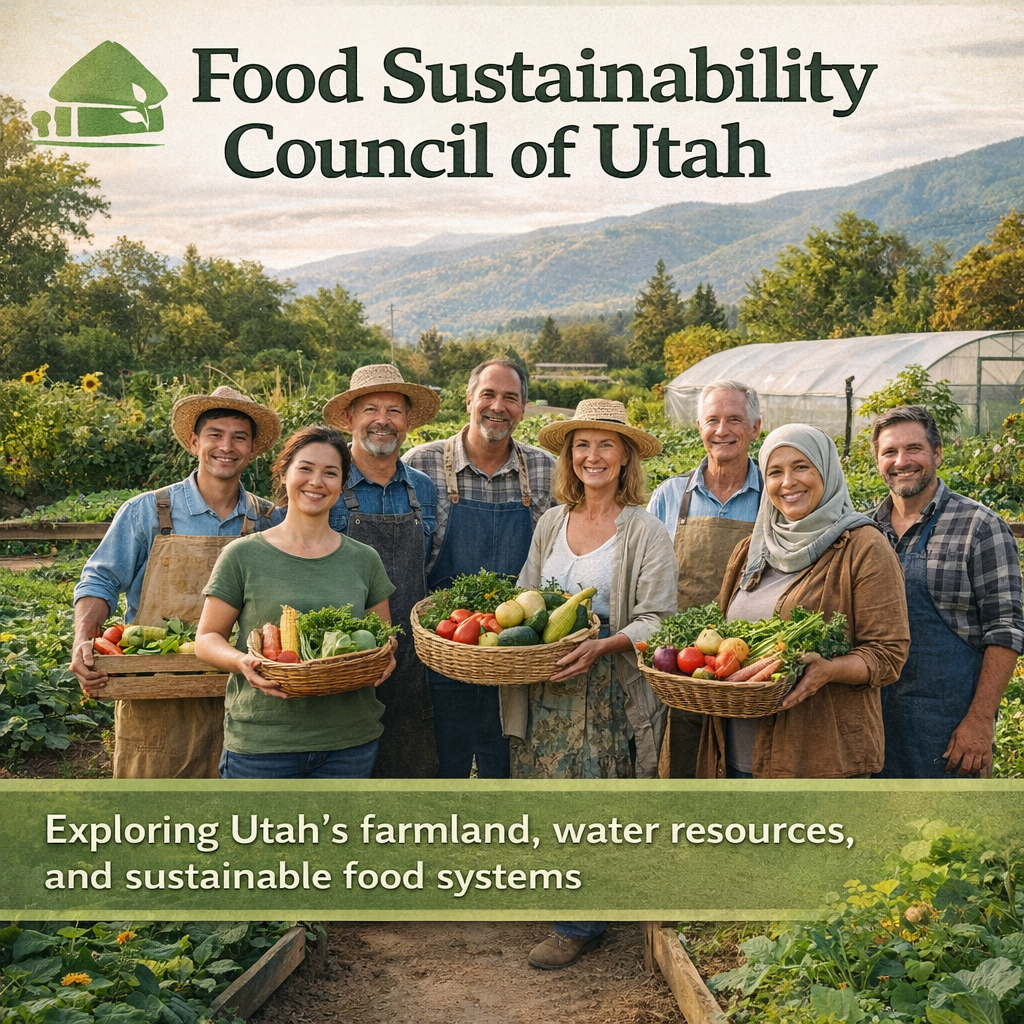
Food Sustainability Council of Utah
Created: October 26, 2025
TVS Sponsored?: Yes
Requires New User Approvals?: Yes
Food, farmland, and water are the foundation of a sustainable Utah. This council brings together farmers, researchers, planners, and community leaders to strengthen the systems that feed our state.
Why This Group Matters
For much of Utah’s history, agriculture has been a defining part of the state’s landscape and economy. Farms and ranches not only produced food for local communities but also shaped the character of the valleys and rural areas where many towns and cities first developed.
Today, that landscape is changing.
Across the state, farmland is gradually being converted to residential and commercial development as Utah experiences rapid population growth. Much of the land most suitable for farming lies in the same valleys where development pressure is strongest. As cities expand, productive agricultural land often becomes the most accessible land for housing and infrastructure.
At the same time, Utah faces increasing pressure on its water resources. Agriculture has historically relied on irrigation systems and water rights that are now competing with growing municipal demand, long-term drought conditions, and changing environmental realities.
These changes raise an important set of questions:
How can Utah continue to grow while still protecting the land and water resources that make long-term food production possible?
Group Description
The Food Sustainability Council of Utah is a TVS-sponsored group focused on understanding and addressing the long-term sustainability of Utah’s food systems.
Across the state, many people are observing a gradual but significant shift. Agricultural lands that once produced food for local communities are increasingly being sold and converted into housing developments, commercial projects, and other forms of urban expansion. For many landowners and farmers, selling land to developers can be the most financially rational choice, as the development value of land often far exceeds what it can generate through agricultural production.
These economic pressures, combined with population growth and development demand, create powerful incentives that steadily reduce the amount of farmland available for future food production.
Water availability is another critical factor shaping the future of agriculture in Utah. Farming in much of the state depends on carefully managed irrigation systems and water rights that are increasingly affected by drought conditions, population growth, and shifting priorities in water allocation. As both land and water resources change, the long-term capacity of Utah to produce food locally becomes an increasingly important topic for discussion.
These issues extend beyond agriculture alone. The loss of farmland affects land stewardship, water management, rural economies, community planning, and the resilience of local food systems. It also connects to broader questions about public health, including the availability of fresh, locally grown, and nutrient-rich foods.
Rather than approaching these issues with predetermined conclusions, the Food Sustainability Council of Utah invites thoughtful and informed discussion about the many forces shaping Utah’s food future. These forces include economic incentives, land-use planning decisions, population growth patterns, water management policies, agricultural economics, and broader cultural and environmental trends.
By bringing together people with real experience and diverse perspectives, the group aims to better understand the dynamics influencing farmland, water use, and food production — and to explore constructive ideas that may help Utah remain both prosperous and sustainable for future generations.
Areas the Group May Explore
Members of this group may examine a wide range of questions, including:
How much farmland has Utah lost over the past several decades, and where is that loss occurring?
• What economic incentives encourage farmland to be sold for development?
• How do city planning decisions, zoning practices, and growth patterns affect agricultural land?
• How do water rights and water allocation policies influence the future of farming in Utah?
• What role does population growth play in shaping long-term land and water use?
• How can agricultural land trusts, conservation easements, or other preservation tools help maintain farmland?
• What role can regenerative agriculture and improved soil stewardship play in long-term sustainability?
• How much of Utah’s food is produced locally versus imported from outside the state?
• What are the connections between soil health, food quality, and public health?
These and other questions can help participants better understand the issue and identify solutions that support both growth and long-term sustainability.
Group Purpose
The purpose of this group is to foster thoughtful discussion, shared insight, and collaborative problem-solving around the long-term sustainability of Utah’s food systems — including farmland preservation, water stewardship, agricultural resilience, and the role of local food in supporting healthy communities across the state.
Who This Group May Be Valuable For
Farmers, ranchers, and agricultural landowners
• Soil scientists and agricultural researchers
• Water resource specialists and irrigation experts
• City planners and regional development professionals
• Agricultural economists and policy researchers
• Nutrition and public health professionals
• Food producers, distributors, and farm-to-table chefs
• Environmental scientists and sustainability professionals
• Land conservation organizations and agricultural preservation groups
• Community leaders interested in the long-term sustainability of Utah’s food systems
Administrator Invitation
We are especially interested in individuals who may wish to help guide this group as administrators — particularly those with meaningful experience in agriculture, water management, soil science, food systems, environmental research, planning, or community leadership related to sustainable food production in Utah.
How to Participate
If this topic connects with your work, experience, or interests, you are welcome to reply through the group if you would like to participate:
Interested in Participating?
If you are actively involved in the performing arts and interested in being part of this community, we welcome your participation.
If you are interested in helping guide the direction of this group:
- Reply to express interest in serving as a Group Administrator
If you would like to participate in the discussions and collaboration:
- Reply to join as a Contributor / Advisor
If you simply want to stay informed and follow the conversation:
- Reply to join as a Group Member
This group is in pre-registration
This group is still being set up. Request to join now and you'll be notified when it's ready!